What Is Training Load and Why Does It Matter?
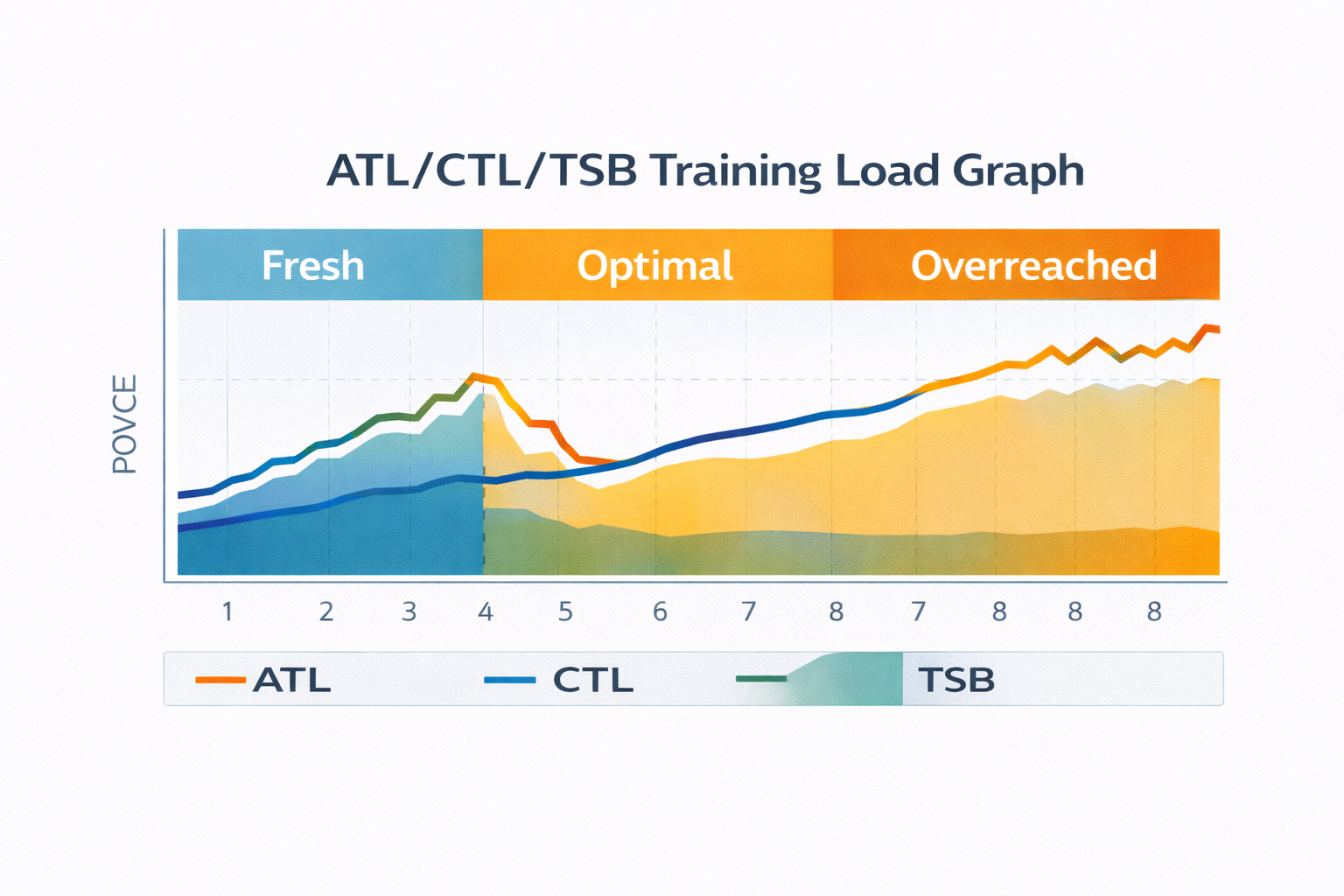
Training load quantifies the cumulative stress your body experiences from exercise. While a single workout might feel easy or hard, it's the accumulated load over weeks and months that determines whether you improve, plateau, or get injured. This tool uses the Training Stress Score (TSS) model developed by Dr. Andrew Coggan, which is widely adopted in cycling and increasingly used across endurance sports including running, swimming, and triathlon.
The concept is straightforward: every workout produces a stress score based on its duration and intensity relative to your threshold. A 60-minute easy ride might score 40 TSS, while a 60-minute race might score 120. By tracking these scores over time, you can monitor your fitness (Chronic Training Load, or CTL), fatigue (Acute Training Load, or ATL), and form (Training Stress Balance, or TSB) — the three pillars of periodized training.
Understanding TSS, CTL, ATL, and TSB
Training Stress Score (TSS) measures the training load of a single workout. The formula is: TSS = (duration in seconds × Normalized Power × Intensity Factor) / (FTP × 3600) × 100. A workout at exactly your threshold (FTP) for exactly one hour equals 100 TSS. Shorter or easier workouts score lower; longer or harder workouts score higher. For runners without a power meter, the tool estimates TSS from heart rate data using the hrTSS method, which calculates load based on time spent in each heart rate zone.
Chronic Training Load (CTL) is a 42-day exponentially weighted average of your daily TSS — it represents your fitness. A higher CTL means you're more trained. Acute Training Load (ATL) is a 7-day average representing recent fatigue. Training Stress Balance (TSB) is simply CTL minus ATL: when TSB is negative, you're fatigued; when positive, you're fresh. The sweet spot for peak performance is a TSB between +10 and +25 after a taper period. This tool calculates all three metrics from your uploaded FIT, TCX, or GPX files and displays them on an interactive chart.
Common Training Load Mistakes
The most dangerous mistake is ramping training too quickly. Sports science recommends increasing weekly TSS by no more than 5–10% per week. A sudden 30% increase in training load is strongly correlated with injury. Another common error is ignoring TSB for too long — chronic negative TSB (below -20 for weeks) leads to overtraining syndrome, which can take months to recover from. Conversely, keeping TSB too positive for too long means you're detraining. The goal is strategic oscillation: build fitness with negative TSB blocks, then recover with short positive TSB periods before key events.
Tips for Using Training Load Data
Upload at least 6–8 weeks of training files to get meaningful CTL/ATL/TSB trends. The more data you provide, the more accurate the analysis. If you switch between devices (e.g., Garmin watch for running, Wahoo for cycling), upload files from all devices. Set your FTP or threshold pace accurately — an incorrect FTP will make all TSS values wrong. Retest your FTP every 6–8 weeks as fitness changes. When planning a race, aim to arrive with a CTL that's 10–15% higher than your baseline, then taper for 7–14 days to bring TSB positive. For wheelchair athletes, the same principles apply — track your training files and adjust activity type settings accordingly.
About This Tool
Training Load analysis helps you understand whether you're building fitness, accumulating too much fatigue, or are ready to race. The three key metrics — CTL, ATL, and TSB — are adapted from Dr. Eric Banister's TRIMP (Training Impulse) model, widely used by endurance coaches.
What is TSS?
Training Stress Score (TSS) quantifies the training load of a single session. It accounts for both intensity and duration. A 1-hour easy run might score 40–60 TSS, while a hard interval session could score 80–120 TSS.
CTL, ATL, TSB explained
Chronic Training Load (CTL) is a 42-day exponential moving average of TSS — your "fitness". Acute Training Load (ATL) is a 7-day moving average — your "fatigue". Training Stress Balance (TSB) is CTL minus ATL — your "form". Positive TSB means you're fresh. Negative means you're carrying fatigue. Racing well usually happens at TSB around 0 to +15.