What is TDEE?
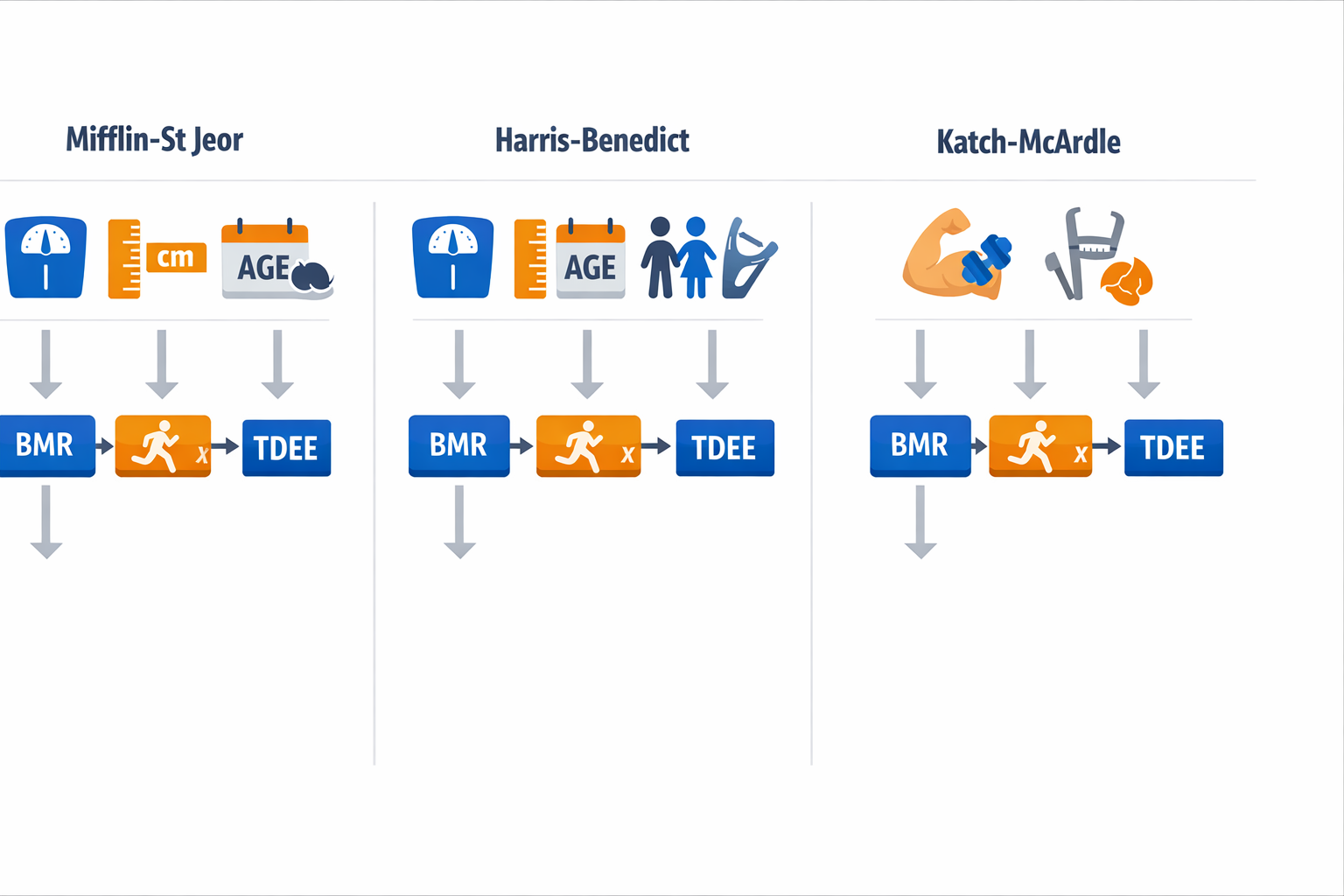
Total Daily Energy Expenditure (TDEE) is the total number of calories your body burns in a day. It accounts for your Basal Metabolic Rate (BMR) — the energy your body needs at rest — plus the calories burned through physical activity, digestion, and daily movement.
Knowing your TDEE is the foundation of any diet plan. To lose weight, eat below your TDEE. To gain muscle, eat above it. This calculator uses three scientifically validated formulas and averages them for the most accurate estimate.
Formulas Used
Mifflin-St Jeor (1990) — Considered the most accurate for most people. Uses weight, height, age, and sex.
Harris-Benedict (revised 1984) — One of the oldest and most widely used equations. Slightly overestimates for overweight individuals.
Katch-McArdle — Uses lean body mass instead of total weight, making it the most accurate if you know your body fat percentage.
Understanding Activity Multipliers
The activity multiplier is the most significant variable in your TDEE — it converts your BMR into a full-day energy estimate. Multipliers range from 1.2 (sedentary, desk job, no exercise) to 1.9 (very active job plus daily training). The key question is not 'how many times a week do I exercise?' but 'how much do I actually move through the entire day?' A person who exercises 5 times a week but sits at a desk for 10 hours a day belongs at a lower multiplier than someone who both trains and has a standing or walking job.
If you are unsure which multiplier to use, start with the one closest to your actual lifestyle and track your weight weekly for 2–3 weeks. If your weight is stable and you want to lose fat, subtract 15–20% from your current calorie intake. If your weight is falling faster than 0.5–1 kg per week, the multiplier may be too low. Adjusting based on real results is more reliable than any formula estimate.
How to Use Your TDEE
For fat loss, aim for a 15-25% caloric deficit below your TDEE. For muscle gain, a 10-15% surplus is recommended. Track your weight weekly and adjust — if you are not seeing changes after 2-3 weeks, adjust your intake by 100-200 calories.
From TDEE to a Diet Plan
For fat loss, a deficit of 15–20% below your TDEE is the standard recommendation for most athletes. A 500 kcal daily deficit produces approximately 0.5 kg of fat loss per week — a rate that preserves muscle mass better than aggressive cuts. Deficits larger than 25% often cause muscle loss, strength decline, and significant fatigue, especially in athletes who need to maintain training performance. Mifflin-St Jeor TDEE × 0.80 is a widely used starting point for a moderate cut.
For muscle gain, a surplus of 10–15% above TDEE is the recommended range. Larger surpluses produce more body fat than additional muscle — the body can only build muscle at a limited rate regardless of calories. For a 75 kg person with a TDEE of 2,800 kcal, a 10% surplus means eating around 3,080 kcal per day. Track your weight over 4 weeks; aim for 0.25–0.5 kg gain per week. If you gain faster, your surplus is too large.
Common TDEE Mistakes
The biggest mistake is overestimating your activity level. Most people who exercise 3–4 times per week should select 'moderately active' rather than 'very active' — the 'very active' multiplier (1.725) is intended for athletes training 6–7 days per week at high intensity, or people with physically demanding jobs who also exercise. Selecting the wrong activity level can overestimate your TDEE by 300–500 calories per day, which completely undermines a caloric deficit for weight loss. A second common error is treating TDEE as a fixed number. Your TDEE fluctuates daily based on NEAT (Non-Exercise Activity Thermogenesis) — fidgeting, walking, standing, and other unconscious movements that can vary by 200–800 calories between sedentary and active days. When cutting calories, adaptive thermogenesis also reduces your TDEE over time as your body downregulates metabolism. Re-calculate your TDEE every 4–6 weeks during a diet phase. For wheelchair users, standard activity multipliers may overestimate lower-body NEAT; consider using the lower end of the activity range and adjusting based on actual results over 2–3 weeks.
TDEE for Adaptive Athletes and Wheelchair Users
Standard activity multipliers are calibrated on able-bodied populations and may overestimate TDEE for wheelchair users because they assume lower-body NEAT (Non-Exercise Activity Thermogenesis). Ambulatory movement — standing, walking, fidgeting — contributes significantly to daily calorie burn in able-bodied people, but wheelchair users with complete paralysis do not generate this component. As a starting point, select the multiplier one step lower than your activity level suggests, then adjust based on real body weight results over 3–4 weeks. Athletes using the Katch-McArdle formula with a measured body fat percentage will get the most accurate estimate since it directly accounts for lean body mass.
Frequently Asked Questions
Why does my TDEE seem to change over time?
Your TDEE decreases during prolonged caloric restriction through adaptive thermogenesis — your metabolism downregulates to conserve energy as you lose weight. This is normal, not a metabolism problem. Every 4–6 kg of weight lost, recalculate your TDEE using your new body weight. During long diet phases, you may need to eat slightly less than the calculated number. Diet breaks (returning to maintenance calories for 1–2 weeks) can partially reset adaptive thermogenesis.
Which BMR formula should I use?
For most people without a known body fat percentage, Mifflin-St Jeor (1990) is the best choice — it was developed from a diverse population sample and consistently outperforms Harris-Benedict in validation studies. If you know your body fat percentage from a DEXA scan or reliable measurement, use Katch-McArdle, which is the most accurate because it uses lean body mass directly. This calculator shows all three and averages them, which reduces the impact of any single formula's errors.